-
Continue reading →: Lean Thinking: The Many Flavors of Waste
The seven types of waste are a foundational concept in lean manufacturing, all forms of muda as described by Taichi Ohno of Toyota. Reducing waste systematically can help you achieve flow in your processes. Waste can result from: Overproduction – making too much of something that goes unused, spoils, or…
-
Continue reading →: Eight Ways to Deal with Complexity
There is not one person I know who doesn’t have to deal with complexity in their work or personal lives. Either the subject matter they work with is complex or specialized, the politics are stressful, or there’s just too much information to process and the information overload becomes oppressive. Fortunately,…
-
Continue reading →: Government Plays a Role in Productivity-Oriented Competitiveness
I read an article this morning about a 13-year old Somalian girl who was stoned to death for being raped. The article also characterized, in simple terms, the social and institutional landscape of her country: Somalia is among the world’s most violent and impoverished countries. The nation of some 8…
-
Continue reading →: What is Technology Management? Part 2
In a previous article I covered the Kearns Six Facet Model as a way to understand what technology management is all about. Universities with technology management programs also offer definitions, including these from the South Dakota School of Mines & Technology, the University of Stuttgart in Germany, and the University…
-
Continue reading →: Quality in your Genes
Is your body programmed to get cancer? How about Parkinson’s, or multiple sclerosis, or diabetes? With 23andme.com, you could find out if you are predisposed to these or 19 other diseases simply by spitting in a cup. In addition, you can easily donate your data to further medical research. These…
-
Continue reading →: Polls, Margins of Error, and Six Sigma Data-Driven Decision Making
One of the most critical skills that a technology manager can have – or any manager, really – is the ability to interpret data and assess whether or not it reflects reality. Why is this important? Because good managers base their decisions at least in part on data, so the…
Hello,
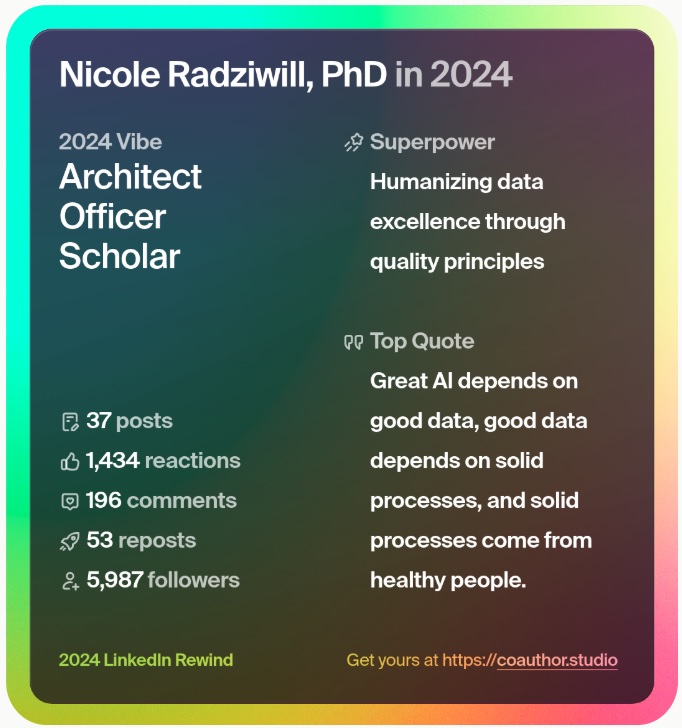
I’m Nicole

Since 2008, I’ve been sharing insights and expertise on Digital Transformation & Data Science for Performance Excellence here. As a CxO, I’ve helped orgs build empowered teams, robust programs, and elegant strategies bridging data, analytics, and artificial intelligence (AI)/machine learning (ML)… while building models in R and Python on the side. In 2025, I help leaders drive Quality-Driven Data & AI Strategies and navigate the complex market of data/AI vendors & professional services. Need help sifting through it all? Reach out to inquire – check out my new book that reveal the one thing EVERY organization has been neglecting – Data, Strategy, Culture & Power.



 Quality and Innovation