
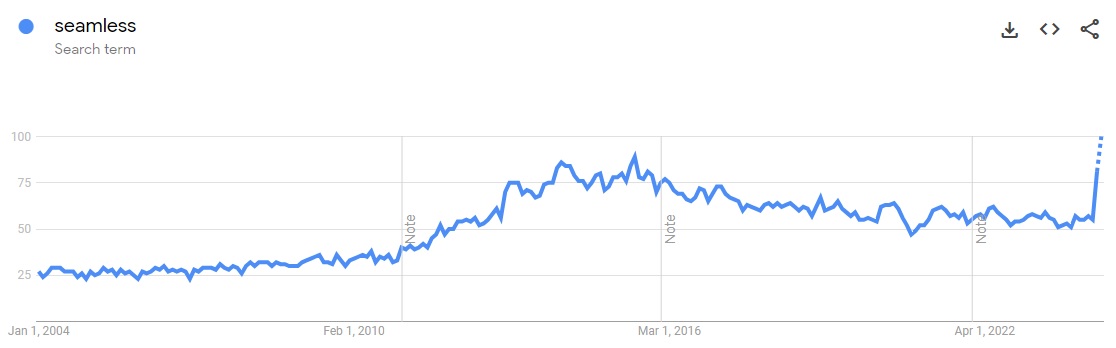
Everybody wants their software and solutions to be “seamless” – just check out Google Trends since 2004! But achieving seamless systems takes more work than just writing a check for a product. The secret is… [well, keep reading!]
The secret is held by data and analytics teams. In most companies, these people do “tech-adjacent” work. They’re not totally part of the tech team, but developers will usually talk to them (at least some of the time). That doesn’t mean tech will cooperate with them or get them what they need to do their work. Often, the data team just has to scrounge up their ingredients from whatever is available.
The members of the data team build reports, create and maintain dashboards, use data to answer business questions, and try to figure out what’s going on underneath the surface when values don’t agree with each other.
And that’s where the work stops… in most organizations.
In contrast – the BEST companies USE that information to help people and business units (literally) get on the same page with each other. They figure out where the discrepancies are, and work together to make changes as close to the source of the problem as possible… up to, and including, aligning how each group thinks about and defines the most essential ingredients of the business: things like definitions of Lead, Customer, Order, or Conversion.
Once any incremental alignment is achieved, data integrity (not-so) magically improves!
Business alignment reflects that all parts of an organization are working towards the same goals and objectives. Without proper alignment, companies generate waste – in the form of inefficiencies, added risks, conflicting priorities, misunderstandings, and wasted resources.
Misalignment leads to reduced productivity, employee disengagement, and (potentially) failing to achieve your company’s objectives. Lack of alignment is also really, really expensive.
Just a couple of years ago, a study by an analyst firm revealed that over $1B in losses could be attributed to misalignment between Sales and Marketing in YOUR organizations. That’s A LOT!
Last week, at MIT’s 2024 Chief Data Officer (CDOIQ) conference, I shared where the real ROI of your data team is coming from: ironing out the discontinuities between people and organizational units. Very few organizations are looking for it there.
While you can’t often see those discontinuities, they cost you a ton of money.
Your data team, however, knows exactly who disagrees with who else in your organization. They know that one person thinks “order” means one thing, but another person’s definition is slightly different – and a third business unit thinks of an order in a completely different way. They know exactly who’s holding back information, who it’s hurting, and whether information that’s being provided to leaders is… wrong. And by how much.
Your data team knows exactly WHO is a silo, and WHY (“that guy who was the head of the division for four years never really did trust anyone else after his incident with the CEO, so we have no way of knowing how they computed key metrics.”) They can tell you which KPIs are high biased, and which are low-biased. And what interpersonal conflicts are at the root of those biases.
The problem with many companies is that they think data teams are responsible for reports, and dashboards, and figuring out why one number over here is different than another number over there. So we assign them the superhuman task of glossing over everyone else’s errors and disagreements to come up with a version of truth that seems meaningful to all of us.
To drive the most ROI from a data team, use them as a lever for quality and continuous improvement: they can prevent errors from reaching your customers, and also try to keep those errors from impacting your internal stakeholders.
Your data and analytics team members are in a perfect position to DEBUG your business (in the great words of Ergest Xheblati)… but when you debug your software, you actually fix the underlying systems… right?
How can you close that loop in your organization? By empowering the data team to advance alignment between people and functional groups… who can’t usually see which gaps to close.




 Quality and Innovation
Leave a Reply