Debanjan Mitra, an Assistant Professor in the Department of Marketing at the University of Florida, is a quality guru – whether quality professionals know it or not. Here’s why: have you ever been frustrated by all those definitions for quality (e.g. the transcendent “you know it when you see it”, Crosby’s “zero defects”, Juran’s “fitness for use”, or the ISO 8402 definition)? I’ve been frustrated too, but Mitra’s work has really helped me make sense of all these different perspectives on what quality is all about.

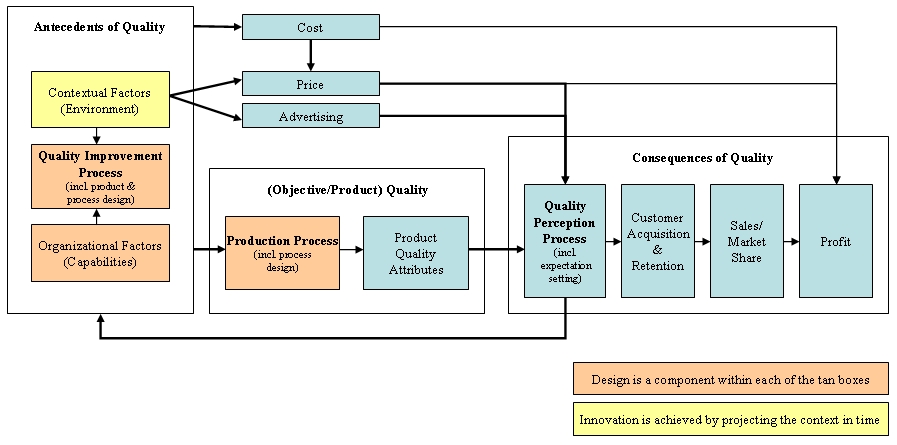
Mitra noticed that across many disciplines, there were different perspectives on what quality was all about. To understand the meaning of quality from the marketing perspective, which is his interest, he investigated over 300 journal articles in different fields. He found that there were five stages of the dynamic process of achieving and improving quality:

  • Organizational antecedents – creating an organization whose capabilities can support achieving world-class quality in products and services
  • Operational antecedents – designing quality into products, managing processes to achieve quality
  • Production quality – meeting specifications for features, reliability and performance; adequately addressing aesthetics and customer taste preferences to create demand
  • Customer consequences of quality – whether and how customers perceive quality, and how this impacts retention
  • Market consequences of quality – in terms of market share, as well as the impact of quality and quality improvement on its contribution to profitability and global competitiveness

Here’s my rendition of Mitra’s original charts, showing the relationships between these areas:
mitra-model

“Zero defects” is an aspect of production quality. “Fitness for use” is part of the customer consequences of quality. Strategy, competitiveness and innovation can be related to any of these five categories, but particularly the market consequences of quality. The ISO 8402 definition is the only one that spans all five stages of the dynamic process.

7 responses to “A Dynamic Model of Quality Improvement”

  1. Management Improvement Carnival #48 « Quality and Innovation Avatar

    […] what that means for your business? If so, check out my 11-28-2008 description of Mitra’s model at A Dynamic Model of Quality Improvement. This really helped me make sense of all the facets of achieving and improving […]

  2. What is Quality? « Quality and Innovation Avatar

    […] framework for understanding quality that’s even more comprehensive and elegant! It’s Mitra’s Model. Hunt, V.D. (1992) Quality in America: How to Implement a Competitive Quality Program. Mc-Graw […]

  3. A Quality-Based Prescription for Stimulating STEM – Part I – Rethink the Educational System « Quality and Innovation Avatar

    […] to recognize that there is a difference between perceived quality and perceived value (according to Mitra’s Model). Here’s the […]

  4. Everybody “Does Quality” | Quality and Innovation Avatar

    […] and Baldrige and ISO standards and continually remind ourselves – and one another – that we simultaneously work with the conditions that give rise to quality, the quality of processes,…quality for tomorrow. We can facilitate explorations of issues like […]

  5. “What is Quality?” – The Best Explanation Ever | Quality and Innovation Avatar

    […] Mitra’s Model (2003), which incorporates the many implied aspects of the ISO 9000 para 3.1.5 definition of quality: […]

  6. Carnival of Quality Management Articles and Blogs – February 2013 « The world is too small? or Is it? Avatar

    […] a view at definitions in the applicable ISO standards provides a refreshing view while discussing Mitra’s Model (2003), which incorporates the many implied aspects of the ISO 9000 para 3.1.5 definition of […]

  7. Quality of Art & Design in the Digital Age | Quality and Innovation Avatar

    […] A subset of Mitra’s model is relevant to examining the quality of art and design. Note that to assess the quality of an example of art, such as a videogame, we might focus more on the objective quality and the consequences of quality, because the antecedents will be more useful if we are attempting to improve quality over time: […]

Leave a Reply

I’m Nicole

Since 2008, I’ve been sharing insights and expertise on Digital Transformation & Data Science for Performance Excellence here. As a CxO, I’ve helped orgs build empowered teams, robust programs, and elegant strategies bridging data, analytics, and artificial intelligence (AI)/machine learning (ML)… while building models in R and Python on the side. In 2025, I help leaders drive Quality-Driven Data & AI Strategies and navigate the complex market of data/AI vendors & professional services. Need help sifting through it all? Reach out to inquire – check out my new book that reveal the one thing EVERY organization has been neglecting – Data, Strategy, Culture & Power.

More About Me or HIRE ME OR MY PEOPLE

Let’s connect