In 1984, my dad bought an Apple IIe. He had never used a computer before, and he didn’t actually plan to learn how to use one, but he knew the most successful people were getting computers. As a successful person, he too would get a computer. And like many modern managers, once the check was written, the job was done. He was now a computer owner.
It sat in a box right outside the closet in his bedroom for months. One day, I noticed that he had cut the packing tape on the box, and I knew it was almost time. I’d be able to use this computer ANY minute now! This was exciting, because I had been programming on my Atari 800 since 1982, and I was tired of the 2-hour spinup process, I had to load the operating system from tape every time I turned it on, and after programming for a while (and enjoying the fruits of my labors), everything would disappear – because I had no media to store any of my programs on.
The Apple IIe was liberation. The future. I watched that box every single day, yearning for the moment I’d be able to sit at the console. But the box never opened, and every request I made (please… can I open the box and set it up today??) was met with a stern admonition and a firm “no, you’re too young for that.”
One afternoon, when both of my parents were out of the house or at work or god knows where (this was the mid 80s, so it was perfectly reasonable for an 8 year old to not know these basic facts) I saw my opening: I was going to disobey and set that darn computer up. I wanted it. I needed it. How would I ever get a decent job if I didn’t know how to use an Apple IIe? (Yes, that’s what went through my mind.) I unpacked the box, got it set up in a half hour or so, and reverberated in the opium of Applesoft Basic AND a fresh new box of actual floppy disks that let me save my work and keep going the next day.
Strangely, neither parent complained when they got home. In fact, no words were spoken at all. My dad broke the box down and moved it into the garage. We had dinner. Fearing consequences, I didn’t mention my feat at all – and I just figured I’d use the computer when no was one home. It felt like a win.
In those days, my dad ran an import business stocking local restaurants with German sausage. He was the only distributor in our region, and his days were spent meeting shipments at the airport and ferrying them around to restaurants. Bratwurst, knockwurst, weisswurst, schinkenspeck, landjaeger, you name it. We were the singular source for German sausage in the southeast.
A couple months after I got the computer set up (and still, no words from either parent) my fears were activated. Over dinner, my dad said “Nicole, we need to talk about the computer.”
I was silent. Surely I was about to be taken care of for my blatant disregard of my parents’ order NOT to touch that computer.
“I need you to write me a Sausage Program.”
Now reader, in those days, I had no idea about requirements or design or even what it meant to write a program for someone else. I did not know what a Sausage Program was. What it would do. Who would use it. When it would be used. Whether these people could use a computer, and where they would get access to the computer. Would I have to set the new computer up at my dad’s office? This wouldn’t work either, because the customers never visited him there.
I tried to ask some of these questions, but he got irritated. “Just write me a Sausage Program. I need to have a Sausage Program.”
Every few days he’d ask me about the status of the Sausage Program. “It’s in progress,” I’d say. Meanwhile, I’d sit in front of the terminal, the lonely green cursor blinking against the deep dark blackness, hoping that I’d somehow figure out how to write a Sausage Program. I prayed for divine inspiration.
Soon, it was fall. “I do need that Sausage Program as soon as you can provide it.” He said it three times in the course of a week. I don’t know what I was afraid of if I didn’t deliver, but I knew it didn’t feel good. I still didn’t know what a Sausage Program should do.
Finally, I just guessed. When you typed sausage.exe, you’d be asked five questions about tastes you liked and didn’t like, and the setting you were trying to cook for (like school lunch, picnic, holiday dinner). The Sausage Program would tell you what kind of German sausage was best for you.
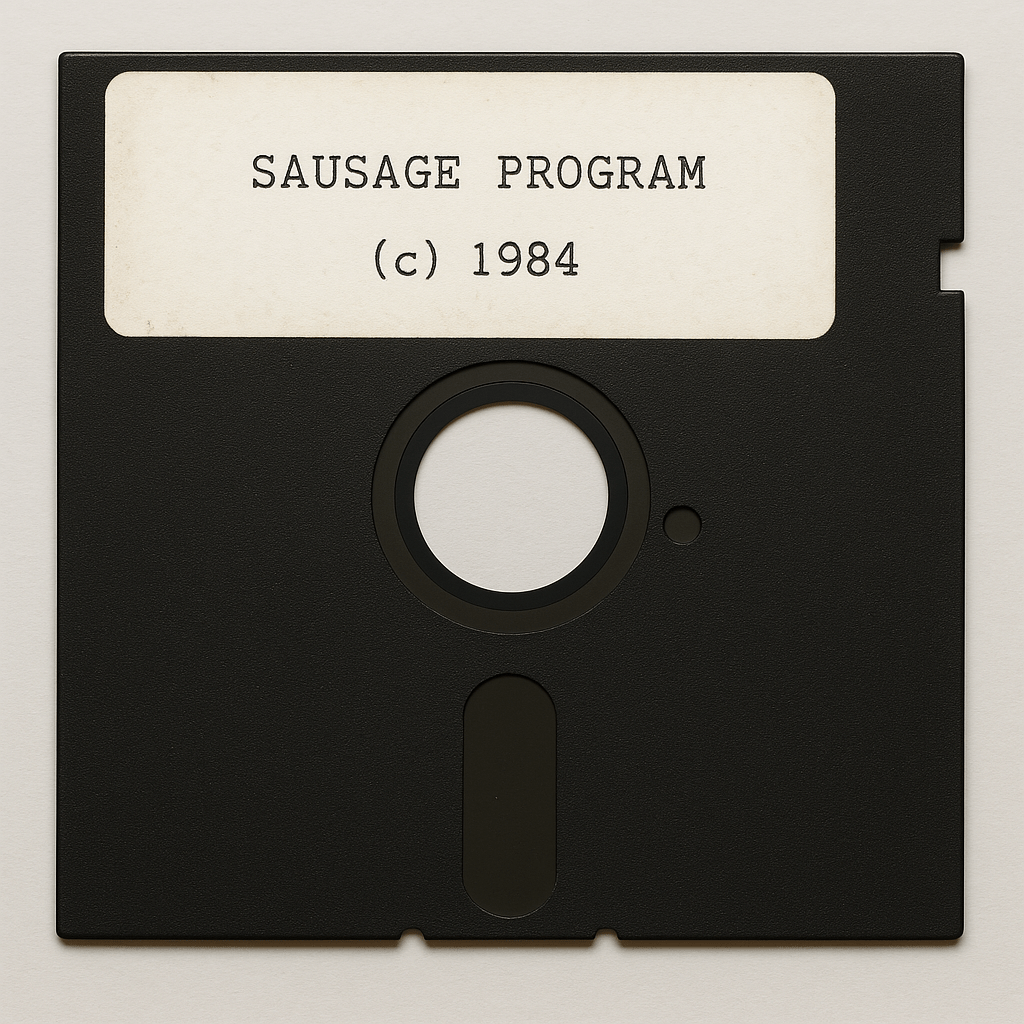
Nervously, I tried hundreds of combinations of answers. I made sure they were as good as they could be. I wrote the file onto the disk, and fed some sticky labels into the IBM Selectric typewriter. I typed “SAUSAGE PROGRAM” and “(c) 1984” because it felt like the professional thing to do. I was sure to type the label before putting it on the disk, because typing onto the label on the disk would damage it.
That night, I handed my dad the disk. “Oh! Thank you. My Sausage Program.” From that point forward he told all of his customers that he was using computers in his business. He did not provide any additional detail about this assertion. His customers were impressed, and bought more sausage.
The disk sat on the end table next to his living room chair for a week. Then a month. Then it was 1985. I’m not sure he even knew it was a disk, or what it did, or how to make the disk do something in the computer. But it didn’t matter. Sometime in the spring, the disk disappeared. “I put it in with the photos,” my mom said. “In case he wants it later.”
I was forlorn. My Sausage Program would never reach a real user.
I didn’t realize then how this situation would repeat, over and over, in my career. It’s happening again now that everyone wants to incorporate AI into their business processes.
Everyone wants a Sausage Program. They might not know what it does, but they know they need it. They know how much it will mean to their customers, even though they can’t always explain what it will do, or for whom.
But they need it this week. And you, software people, might have to figure out what that means. May the force be with you all.





 Quality and Innovation
Leave a Reply