
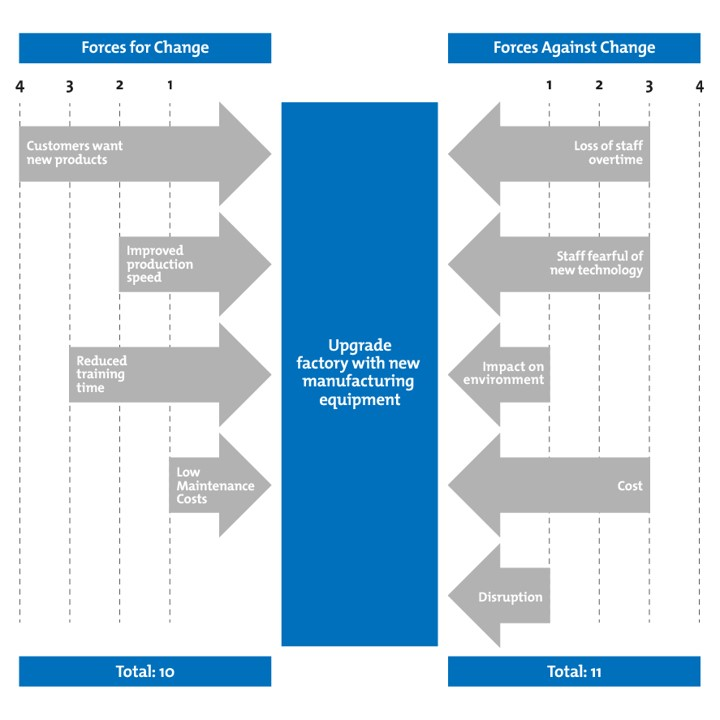
In Tom Redman‘s excellent 2024 book People and Data, he explains that non-data people are the solution to data problems across an organization! He illustrates how to use Lewin’s Force Field Analysis (FFA; example below) to begin the process of making change actionable. “To accelerate progress, you can enhance the driving forces, add new ones, or mitigate the restraining forces.”
I really like this approach because it shows how you can combine the findings in his book and my 2024 book Data, Strategy, Culture & Power (which overwhelmingly focuses on how people can be the problem)! This weekend, I spent some time extracting some restraining forces to consider if you’re doing a Force Field Analysis to assist with change management around data in your company:
Psychological Forces
- Overconfidence in the quality of data and the systems that produce it, or the belief that if data comes from enterprise SaaS software, it must be good. This can lead to complacency, and a lack of attention to detail. This can result in missed opportunities for improvement, ultimately eroding data quality.
- Conviction in one’s beliefs and biases. This can lead to a failure to consider alternative perspectives or interpretations, and ultimately, to decisions based on incomplete or inaccurate information.
- Apathy stemming from a lack of engagement or a “box-checking” culture. Apathy can lead to a tolerance for deviations and a lack of attention to detail, which can compromise data quality.
- Fear stemming from the power dynamics in the workplace. Fear can lead to a lack of transparency, where employees may hesitate to report data errors or inconsistencies due to fear of repercussions.
- Ignorance of the complexities and challenges of data management. Not understanding how easy it is for data to degrade can lead to poor data practices and a failure to allocate appropriate resources for data management.
Interpersonal and Social Forces
- The pressure to conform to a company’s culture or leadership’s expectations. This can lead to a lack of independent thought and a willingness to address issues from inaccurate or incomplete data.
- Psychological manipulation. Subtle pressure, “kissing the ring” cultures, and the threat of consequences like layoffs can be used to control employees and discourage them from raising concerns about data quality.
Organizational and Systemic Forces
- Unrealistic expectations and a culture of urgency. When employees are constantly under pressure to deliver results, they may prioritize speed over data integrity.
- Perverse incentives that reward the wrong behaviors. When employees are incentivized to produce quantity over quality, data quality can suffer.
- Lack of alignment between different departments or teams. This can lead to inconsistencies in data definitions and practices, making it difficult to maintain data quality. On a force field diagram, you’d want to include one restraining forces arrow for every
Environmental and Contextual Forces
- A chaotic and complex data ecosystem. A fragmented and disorganized data infrastructure can make it difficult to track data lineage and ensure data quality. The more components that are in your data stack, the more complex and potentially chaotic you’re likely to be.
- The natural tendency towards entropy. Without proper maintenance and governance, data quality will degrade over time.







 Quality and Innovation
Leave a reply to iamvistinginstructoreric Cancel reply